
The peacock does not produce a single cry, but rather a structured vocal repertoire where each call serves a specific function. Ornithological research distinguishes several categories of vocalizations in the Indian peafowl (Pavo cristatus), related to courtship, alertness, or maintaining social contact. Understanding these calls is to read a system of animal communication that is much richer than the famous “Leon” that popular culture remembers.
Vocal repertoire of the peacock: calls classified by function
Reducing the peacock’s cry to a shrill and unpleasant sound is akin to confusing a word with an entire language. Ornithologists identify several types of calls, each associated with a distinct behavioral context.
| Type of call | Context | Sound characteristics |
|---|---|---|
| Courtship call | Reproduction, presence of females | Powerful and repetitive cry, often emitted at dawn and dusk |
| Alert call | Detection of a predator or intruder | Brief, high-pitched sound, emitted in rapid bursts |
| Contact call | Communication between individuals of the group | Lower, modulated vocalization, short range |
| Territorial call | Defense of territory by the male | Long and deep cry, repeated at regular intervals |
This table simplifies reality, as the same call can vary in intensity and frequency depending on the season. During the breeding season, courtship vocalizations largely dominate the male’s repertoire.
To delve deeper into the different cries of the peacock and their roles in the bird’s daily life, one must go beyond mere sound observation and examine the behavior associated with each vocalization.
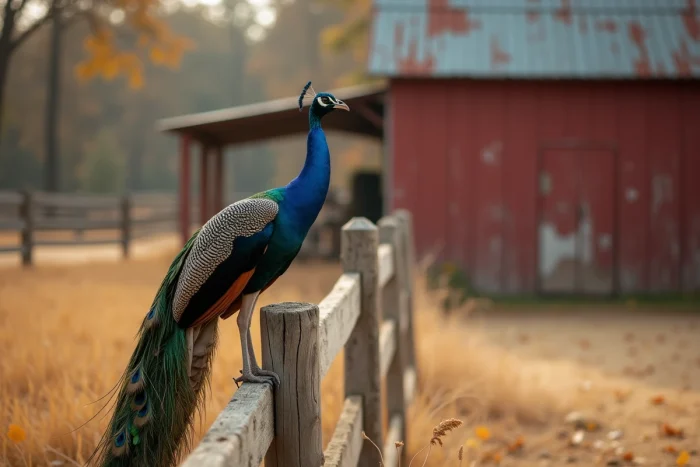
Courtship cry of the peacock: a sexual and social signal
The most well-known cry of the peacock, which can be heard hundreds of meters away, is directly related to reproduction. The male emits it in conjunction with his display, this spectacular deployment of iridescent feathers. But the acoustic signal is not limited to accompanying the visual.
Behavioral observations show that the courtship cry captures the attention of females even before they see the display. The sound acts as a preliminary call, an announcement that precedes the spectacle. The female (peahen) turns her head towards the sound source, then approaches if the signal corresponds to a male in good physical condition.
Infrasound produced during the display
The display is not limited to audible sounds. The peacock’s feathers vibrate during the display and produce infrasound, frequencies too low for the human ear. These vibrations constitute an additional communication channel, perceptible by females at short distances.
This dual channel (audible cry and infrasound) makes the peacock’s display a rare multimodal communication system among birds. The male does not just rely on beauty: he simultaneously emits visual, acoustic, and vibrational signals.
Alert cries of the peacock: sentinel of the group
The peacock is not just a noisy seducer. Its alert cry, distinctly different from the courtship call, serves a defensive function for the entire social group. This brief and high-pitched cry is emitted as soon as a terrestrial or aerial predator is spotted.
In rural areas where peacocks live in semi-freedom, this alerting ability has long been recognized. The bird reacts to suspicious movements well before other poultry. The peacock plays a natural sentinel role in mixed backyards, alerting hens, geese, and ducks.
- The terrestrial alert cry is a series of high-pitched and closely spaced notes, often accompanied by an upright neck and a frozen posture
- The aerial alert cry, triggered by the passage of a raptor, is shorter and causes the immediate dispersal of the group on the ground
- Peahens also emit alert cries, but at a lower volume, especially when protecting their young (peafowl chicks)
Symbolic meaning of the peacock’s cry in cultural traditions
Beyond biology, the peacock’s cry carries symbolic meanings that vary significantly from one culture to another. In India, where the Indian peafowl is the national bird, its vocalizations are associated with beauty, pride, and a form of spiritual wealth. Hindu tradition links the peacock to the god Kartikeya, and its cry is sometimes interpreted as an expression of sacred joy.
In some Asian cultural traditions, the peacock’s cry is perceived as a harbinger of rain. This belief is based on the observation that peacocks vocalize more during overcast weather or before storms, likely in response to changes in atmospheric pressure.
The peacock in French literature
French literature has primarily focused on the visual aspect of the peacock (“to strut like a peacock” to denote vanity), but its cry also appears in texts where it symbolizes a contrast between beauty and dissonance. The most majestic bird produces a sound that many find unpleasant, which has fueled a literary paradox for centuries.
This tension between the visual and the auditory is reflected in the very nature of the animal. The plumage is a tool for silent seduction, while the voice serves territorial and defensive communication. Beauty and vocal power serve distinct functions in the life of the peacock.
Vocal differences between peacock species
The genus Pavo includes two main species: the Indian peafowl (Pavo cristatus), native to South Asia, and the green peafowl (Pavo muticus), found in Southeast Asia. The Congo peafowl (Afropavo congensis) belongs to a distinct genus. Vocalizations differ significantly between these species.
- The Indian peafowl produces the most powerful and frequent cry, with repeated calls during the breeding season
- The green peafowl emits generally lower and less shrill vocalizations, adapted to its denser forest habitat
- The Congo peafowl, more discreet, vocalizes rarely and at low volume, making its acoustic study more complex
These differences reflect adaptations to distinct environments. A powerful cry carries better in open terrain, while a low call penetrates dense vegetation more effectively. The peacock’s cry is shaped by its habitat as much as by its biology.
The vocal repertoire of the peacock constitutes a rich case study for behavioral ornithology. Each type of call, from courtship to alert to social contact, corresponds to a specific adaptive need. Reducing this bird to its plumage is to ignore half of its communication system.