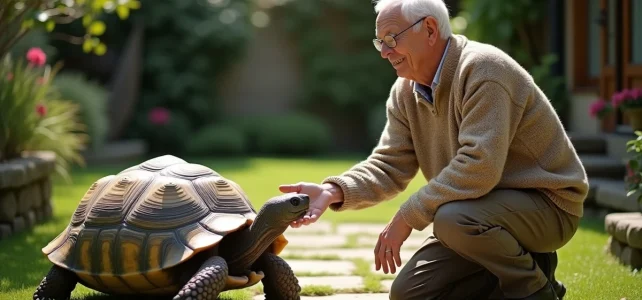
A raw figure: with certain turtles, associative memory extends over several months, well beyond mere food-seeking. This challenges the caricatured view of the cold and distant animal.
In reality, things are not so simple. Attachment, or rather the recognition of a human being, works in turtles through mechanisms quite different from those that connect dogs or cats to their owners. Don’t expect devotion or clear loyalty: here, everything goes through conditioning, routine, and the repetition of daily encounters. It is then difficult to see a true individual identification, at least according to our usual human criteria.
What science reveals about turtle memory
It would be to deprive oneself of an exciting reality to neglect turtle memory. For years, scientists and ethologists have scrutinized these reptiles closely. From their observations emerges a profile much more nuanced than the dusty one of inert creatures governed by instinct. Regardless of the context, whether in the Galápagos Islands, Aldabra Atolls, or Mediterranean forests, memory appears as a crucial tool for navigation, returning to a specific site, or even, on occasion, recognizing familiar individuals, including humans.
Rigorous experiments show: these animals can remember routes, absorb silhouettes, and memorize colors over the years. Their memory is primarily based on three sensory axes: sight, smell, and hearing. It is the repeated association of images, sounds, or smells with certain events, such as the arrival of food or soothing gestures, that forges this unique recognition.
However, it would be misleading to project our own emotional codes onto turtles. Their memory is grounded in the concrete, in renewed experience, in attention to the present moment. No symbolic reminiscence, no sentimental attachment: only a succession of integrated, effective actions useful for their daily lives.
So, does the turtle recognize its owner? The facts converge: a form of recognition is observed in them, but stripped of the emotional weight or conscious intentionality one would expect. The turtle learns, through repetition, to spot a silhouette, to recognize the timbre of a voice, or a smell associated with care. It is these cues, and the immediate stakes attached to them, that condition its reaction: an opportunistic relationship, not a thoughtful complicity.
Does the turtle really recognize its owner? Distinguishing fact from fiction
It is impossible to ignore the debate that rumbles on: does the turtle really perceive the human it interacts with, or is it a human interpretation? On this subject, research is clear. The bond bears no resemblance to those woven by domestic mammals. The turtle does not respond to calls, avoids prolonged tactile contact. For it, the human mainly embodies routine, predictability, a regular source of food, or familiar gestures.
Nevertheless, certain facts draw attention. On the islands where the giants live, testimonies recount the ability of some turtles to memorize the gait of their caregiver, the sound of a recorded voice, and sometimes even the sequence of gestures in a feeding ritual. The persistence of these memories over long periods intrigues specialists. But each time, it is the regularity and the prospect of a favorable interaction that establish recognition: not an attachment, but a pragmatic logic.
Thus, it is a memory of events and routines. The turtle does not conceptualize the relationship: it perceives what is concrete, what has been experienced multiple times. This way of being builds, over time, a unique dynamic, revealing another dimension of the human-animal relationship.

Signs of recognition: how to interpret your turtle’s behavior in daily life
Observing a turtle requires patience. In its case, there are no insistent looks or rushes towards its keeper: the signs of recognition are subtle, inscribed in repetition, rarely spectacular. One cannot hope for a noisy welcome or a demonstrative rush. Everything plays out in subtlety, sometimes on the edge of the indiscernible.
To spot these faint marks of familiarity, one must pay attention to certain frequent behaviors:
- At mealtime, the turtle moves towards the person who feeds it, adopting a slow but targeted path.
- A sound, a voice, or a familiar silhouette is enough to prompt it to emerge from its hiding place or to become animated as soon as someone steps into the enclosure.
- If a stranger approaches, or if an unusual detail appears, it may choose to flee, abruptly retracting into its shell or remaining frozen: a way to differentiate what is known from what is not.
In detail, sensory memory also manifests in other attitudes: a sustained orientation towards the caregiver’s hand, a trusting stillness during handling, sometimes even a gentle bump of the forehead against fingers or the shell. While some turtles become curious and more easily tolerate human presence, others prefer distant observation and caution before any contact.
Decoding these signals takes time and requires consistency. Through the accumulation of these shared experiences, a silent relationship takes shape, respectful of the animal’s pace. The turtle’s memory is not deficient: it proves to be persistent, effective, always faithful to lived experience. An invitation to recognize the diversity of animal intelligence and to move beyond clichés about the notion of “owner.”