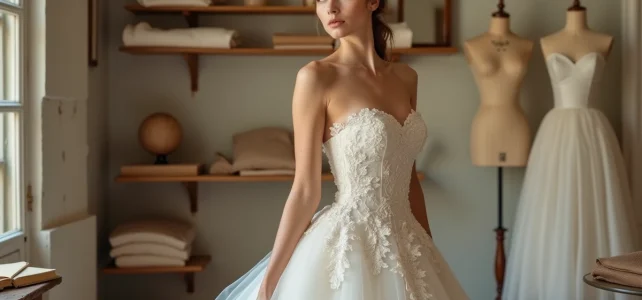
Chantilly lace stands out from other bridal laces due to its structure: a network of very fine silk or cotton threads, worked on a nearly transparent tulle background, with floral patterns outlined by a contour thread called cordonnet. This construction gives it its characteristic lightness and fluid drape, two properties that directly influence the appearance on a wedding dress.
Tulle Background and Cordonnet: Understanding the Structure of Chantilly Lace
Not all Chantilly laces are created equal, and the difference lies in the thread scale. The tulle background forms the invisible base of the fabric. The finer it is, the more ethereal the lace appears and allows the skin to softly show through. A tulle that is too stiff or too thick breaks the lightness effect that is the signature of Chantilly.
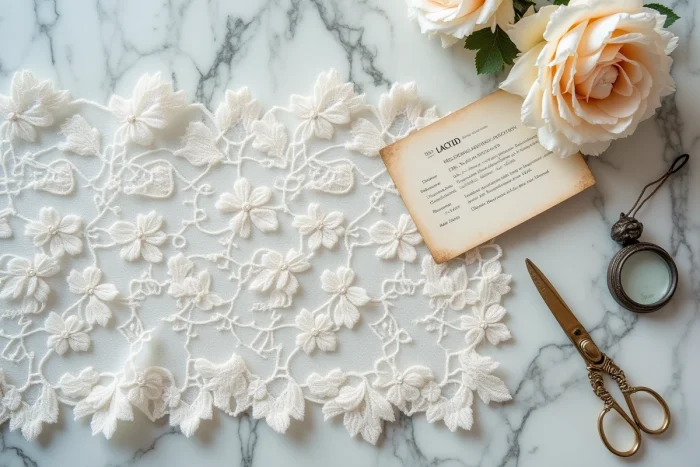
The cordonnet, this slightly thicker thread that outlines each motif, defines the sharpness of the design. On quality Chantilly, the cordonnet is consistent and creates precise outlines without weighing down the fabric. On a lower-quality version, it can be irregular, creating a blurred appearance once placed on the dress.
Before making your choice, it is worth choosing Chantilly lace for your wedding by comparing several samples side by side, ideally in natural light. The contrast between a supple tulle background and a well-defined cordonnet is immediately noticeable to the touch and in backlight.
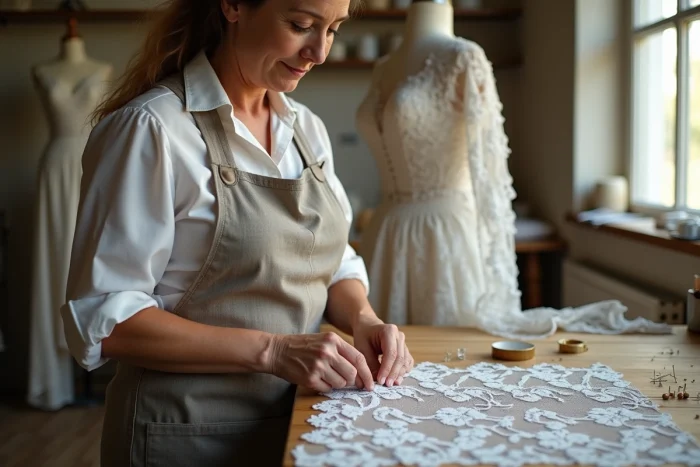
Chantilly Lace on Leavers Looms: The Manufacturing Criterion That Changes Everything
The manufacturing method determines both the flexibility, fineness, and durability of the lace. The main distinction is between lace woven on Leavers looms and lace produced by mechanical embroidery on tulle.
The Leavers looms, used notably in the Calais-Caudry region, replicate the principle of traditional braiding: each thread interlaces with its neighbors to form the motif and the background simultaneously. The result is a lace where the patterns are integrated with the tulle, without bulk. The collective brand “Dentelle de Calais-Caudry,” managed by the French Federation of Laces and Embroideries, certifies this origin and process.
In contrast, embroidered lace on tulle overlays a sewn motif on a pre-existing background. The result can be appealing, but the relief differs: the motifs stand out more and the fabric loses fluidity. For a flowing bohemian-style dress or a fitted dress where the lace hugs the curves, Leavers Chantilly offers a drape that mechanical embroidery cannot replicate.
New Chantilly Lace or Deadstock from Fashion Houses
In recent years, a parallel circuit has developed around the dormant stocks of major fashion houses. Suppliers offer Chantilly lace sourced from end-of-rolls of haute couture production, sometimes through textile upcycling platforms like Nona Source (an initiative supported by LVMH).
The interest is twofold: access to a quality of material usually reserved for fashion shows, and reducing the ecological footprint by reusing already produced fabric. The pattern will be unique, and the meterage limited, which requires designing the dress based on the available fabric, not the other way around.
Chantilly and Dress Silhouette: Successful Combinations
The lightness of Chantilly makes it versatile, but certain uses showcase it better than others. The choice depends on the area of the body where the lace will be placed and the desired effect.
- Sleeves and upper bust: the transparency of the tulle background creates a second-skin effect. Chantilly works particularly well on long or three-quarter sleeves, where it adorns the arm without weighing it down.
- Skirt and train: layered over a silk or crepe underskirt, Chantilly adds visual depth without altering the fluidity of the drape. The floral patterns gain relief thanks to movement.
- Strapless or open-back: a panel of Chantilly placed on a plunging back plays with transparency for a covered yet revealed effect. The cordonnet structures the design and avoids the “naked fabric” look.
- Dress entirely in Chantilly: reserved for straight or slightly flared cuts. On a voluminous crinoline dress, the fineness of Chantilly gets lost in the folds and loses its appeal.
Care and Preservation of Chantilly Lace on a Wedding Dress
The fineness that gives Chantilly its charm also makes it more vulnerable than thicker laces like guipure. A few practical precautions can extend its lifespan.
Direct ironing is to be avoided. Heat applied without protection can melt synthetic threads (if the lace contains polyamide) or shine silk threads. A steam iron held at a distance or an iron on low temperature with a cotton cloth in between is sufficient.
For cleaning after the ceremony, a specialized dry cleaner for delicate textiles remains the safest solution. Machine washing, even on a delicate cycle, risks snagging the cordonnet threads in the drum. If the dress is to be preserved, flat storage in acid-free tissue paper prevents breakage creases that weaken the tulle over the years.
The material of the lining also plays a role: a high-quality silk or crepe lining limits friction that wears down the lace from underneath. A rough synthetic lining can, over time, create micro-snags invisible to the naked eye but perceptible to the touch.
The choice of Chantilly lace for a wedding dress relies on precise technical criteria: fineness of the tulle background, consistency of the cordonnet, manufacturing method on Leavers looms, and suitability with the dress cut. A well-chosen and properly maintained Chantilly retains its flexibility and transparency decades after the ceremony.