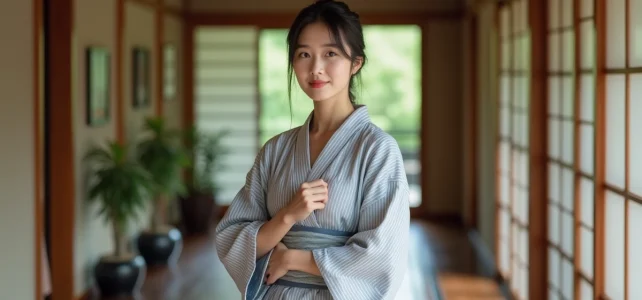
Wearing pajamas in a Japanese hotel is not just about nighttime comfort. The garment provided in the room, its name, cut, and the spaces where it is allowed vary depending on the type of accommodation. For a traveler packing their suitcase before a stay in Japan, the question deserves to be asked before departure: should you bring your own nightwear, and where can you walk around in loungewear once you are there?
Yukata, pajamas, room wear: what each Japanese accommodation provides
The generic term used by Japanese hotels is room wear, but the reality covers very different garments depending on the establishment. Confusion between yukata, Western pajamas, and modern room wear is common among travelers, and it has practical consequences on what you pack in your bag.
| Type of accommodation | Provided garment | Use in common areas | Take home? |
|---|---|---|---|
| Traditional ryokan | Yukata (light cotton kimono) with obi | Encouraged throughout the establishment, including the dining room and hallways | No (property of the ryokan) |
| Hotel with onsen | Yukata or room wear depending on the range | Allowed in indoor spaces, sometimes up to the immediate outside | No |
| Business hotel (APA Hotels, Super Hotel, etc.) | Pajamas or light room wear | Allowed in hallways and laundry room, not in the lobby | No |
| International chain hotel | Sometimes no nightwear provided | Not applicable | – |
The distinction between ryokan and business hotel is the most significant. In a ryokan, the yukata is an integral part of the experience: guests wear it upon arrival, walk around in yukata in the hallways, go to the baths, and dine in traditional attire. In a business hotel in Tokyo or Osaka, room wear remains a bedroom garment.
The possibility of wearing pajamas in a hotel in Japan in common areas therefore directly depends on the category of accommodation chosen when preparing for the trip.
Lobby and common areas: where is Japanese pajama wear accepted?
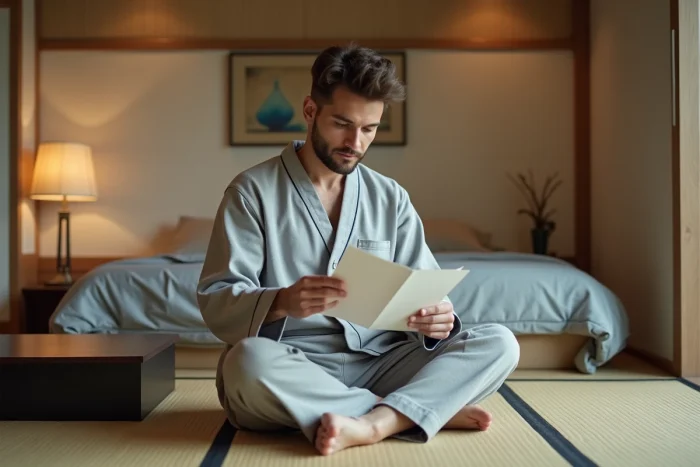
The unspoken rule varies from one establishment to another, but a principle emerges quite clearly. In ryokan and hotels with onsen, the yukata is an expected dress code in almost all indoor spaces. The staff, other guests, and the layout of the places signal that loungewear is the norm.
In contrast, in business hotels and Western chains located in Tokyo or Osaka, room wear is not intended to be worn outside the room. Several hotel groups have added multilingual notes after the reopening of borders (2022-2024) specifying this limit.
The English regulations of Super Hotel Premier Tokyo Station, updated in 2023, indicate, for example, that room wear is allowed in hallways and the automatic laundry room, but not in the lobby or outside the building.
This distinction may seem minor, but it avoids an awkward moment at the reception. Before heading down to the lobby in pajamas, check the instruction sheet placed in the room: most Japanese hotels specify the authorized areas there.
Obi, color, and signage: a discreet dress code in ryokan with onsen
A detail rarely mentioned in travel guides concerns the obi belt provided with the yukata. In some ryokan and hotels with onsen, the color or pattern of the obi is not only used to fasten the garment. It plays a signaling role to guide guests to the correct bath (men/women separation).
This system is documented in the guest guides of certain establishments, such as those of Hoshino Resorts KAI Nikko (2023 edition). The principle is simple: at the entrance of the baths, the color of your belt confirms that you are accessing the correct space. For a traveler who does not read Japanese, paying attention to the obi provided in the room avoids an embarrassing mistake.
The way to tie the yukata is also important. The left side overlaps the right side, the opposite being reserved for funeral ceremonies. This point of dress practice is often illustrated by a diagram in the room.
What to check before going to the baths
- The color of the provided obi and its correspondence with the bath assigned to you (indication displayed at the entrance of the baths or in the room guide)
- The closing direction of the yukata: left side over the right side, always
- The possible presence of a separate towel or bag for the baths, often provided separately from the yukata
Packing your suitcase: should you bring pajamas to Japan?
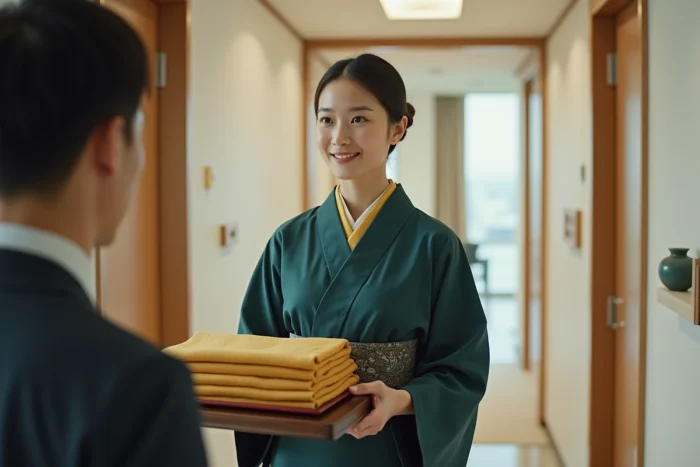
The answer depends on your itinerary. If your stay includes at least one night in a ryokan or hotel with onsen, the provided yukata will replace your pajamas. There is no need to take up space in your bag for nightwear that the establishment provides.
For nights in business hotels or hostels in major cities, the situation is more variable. Some chains provide light room wear, others do not. High-end international hotels often do not provide any nightwear. It remains wise to pack a compact pair of pajamas if you alternate between several types of accommodation.
- Ryokan or hotel with onsen: yukata provided, no need for personal pajamas
- Japanese business hotel (APA Hotels, Super Hotel): room wear generally included, but check before departure
- International hotel or hostel: personal pajamas recommended, no nightwear guaranteed
- Indoor shoes: slippers are provided in the vast majority of Japanese accommodations, including business hotels
One last point to note: pajamas and yukata provided by Japanese hotels are not intended to be taken home. Several hotel chains, including APA Hotels, now print their waste reduction policies on the room wear itself, with no automatic renewal of the garment during the stay. Slipping a yukata into your suitcase upon departure is neither intended nor tolerated by the establishments.
The question of pajamas in hotels in Japan boils down to a simple check: the type of accommodation booked determines the garment provided, the spaces where it is accepted, and what you need to add to your suitcase. Reading the instruction sheet in the room upon arrival remains the most reliable reflex.