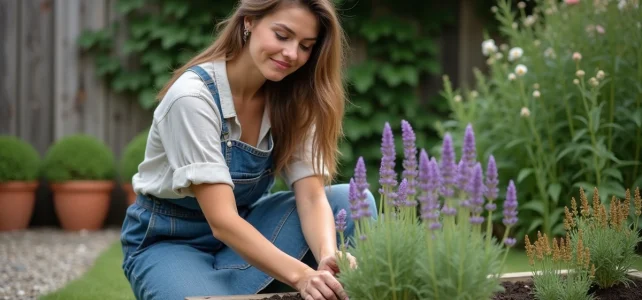
Creating a natural and flowering garden requires answering a question rarely posed in inspiration guides: which plants and practices allow for a colorful flowerbed to thrive in the dry summer without increasing watering or interventions?
Most articles focus on the aesthetic choice of flowers or the spring peak. The real challenge lies elsewhere, in the garden’s ability to function with little water and minimal maintenance throughout the hot season.
Living soil and mulching: the foundation of a drought-resistant flowering garden
Before choosing any plant, the soil conditions everything. Bare soil exposed to the sun loses its moisture within a few days. A covered soil retains it for several weeks.
Organic mulching (wood chips, fallen leaves, straw) acts as a thermal insulator. It limits evaporation, nourishes microbial life, and reduces weed pressure without resorting to chemical weeding. Temporary covering at the beginning of the season complements this approach in the most invaded areas.
A sufficiently thick mulch halves the watering frequency on most clay or loamy soils. On sandy soil, the effect is still notable, but it must be compensated with a deep organic matter addition. Several resources detail concrete approaches to creating a sustainable outdoor space, such as the site La Petite Maison dans la Prairie, which addresses garden design from various practical angles.
Too many gardeners overlook this step and invest in expensive plants that wither by July. Preparing the soil before planting is the opposite of the usual reflex, but it is what separates a fleeting flowering garden from one that lasts the season.
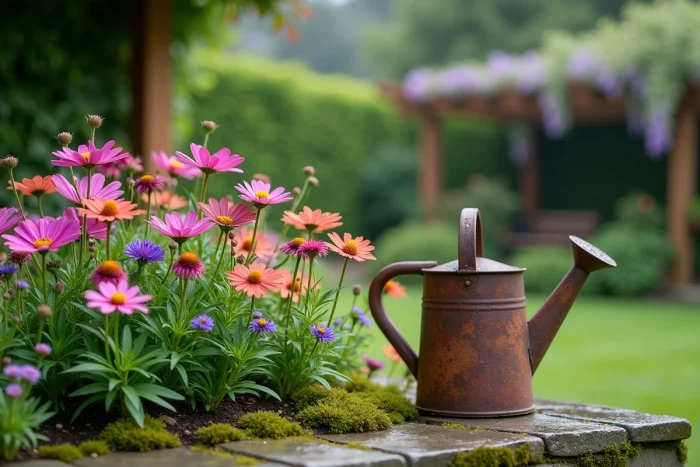
Native and perennial plants for a flowering garden all year round
The continuity of blooms is not achieved by accumulating varieties. It relies on a strategic selection of plants whose blooming periods alternate.
Why prioritize native plants
Native and naturalized plants are adapted to the local climate. They require less water, withstand heat episodes better, and attract local pollinators (bees, bumblebees, butterflies). In contrast, imported horticultural varieties often demand artificial watering and soil conditions that increase maintenance.
A flowerbed primarily composed of native perennials remains in bloom without annual replanting. This is a saving of time, money, and resources.
Structuring blooms season by season
| Season | Examples of suitable plants | Particularity |
|---|---|---|
| Spring | Primroses, daffodils, muscaris | Early bloom, little watering needed |
| Summer | Yarrow, lavender, echinacea | Tolerate drought and poor soils |
| Autumn | Asters, sedums, Japanese anemones | Extend colors until frost |
| Winter | Hellebores, heathers | Persistent structure, discreet bloom |
The goal is not to have a permanent fireworks display but to ensure that at each period, something is blooming or providing structure. Lavender and yarrow are the most reliable duo for a dry summer, as they can withstand weeks without rain once well-rooted.
Designing the natural garden: materials and structural elements
A natural garden is not limited to plants. The materials used for paths, borders, and resting areas directly influence the ambiance and maintenance.
Natural materials (local stone, raw wood, draining gravel) age better than concrete or plastic. They blend into the landscape without creating visual disruption. Gravel, in particular, allows for the creation of circulation areas that drain rainwater towards the flowerbeds rather than directing it to the drainage systems.
- Free hedges (not trimmed into geometric shapes) serve as windbreaks, wildlife refuges, and backdrops for flowering beds. They require trimming at most once a year.
- Dead wood left on the ground or in piles provides habitat for beneficial insects and hedgehogs, two allies against garden pests.
- A water point, even modest (dish, small pond), attracts birds and amphibians that naturally regulate slug and aphid populations.
Each structural element serves an ecological function in addition to its aesthetic role. It is this dual function that distinguishes a natural garden from a simply decorated one.
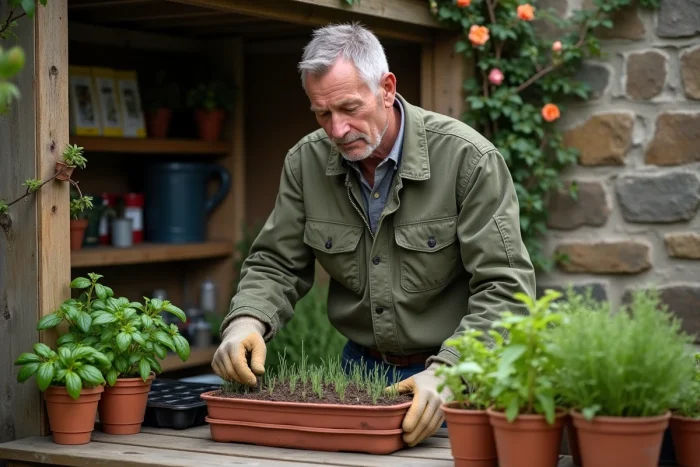
Minimal maintenance of a flowering garden: the gestures that really matter
The maintenance of a natural garden boils down to a few targeted interventions, far from the weekly schedule implied by mowed lawns and annual flower beds.
In the first year after planting, regular watering remains necessary to allow for rooting. This is a temporary investment. By the second year, well-chosen perennials and mulching reduce watering to a few applications in case of prolonged heatwaves.
Weeding is done by hand on unwanted young shoots before they go to seed. Combined with mulching and occasional covering, this gesture is enough to contain weeds without chemicals.
- In autumn, leaving the dry stems in place protects the roots from frost and provides winter shelter for insects.
- In spring, a single cleanup of dead stems and an additional layer of mulch restart the cycle.
- The addition of natural fertilizer (homemade compost, nettle manure) is done once or twice a year, no more.
A well-designed natural garden requires less maintenance time than a conventional lawn. The time saved on mowing and watering more than compensates for the few hours of manual weeding at the beginning of the season.
The natural and flowering garden is not measured by the number of species planted or the size of the land. It relies on three technical choices that mutually reinforce each other: soil protected by mulching, plants adapted to the local climate, and structural elements that fulfill a concrete ecological role. A small space designed according to these principles produces more flowers, for longer, than a large poorly prepared garden.