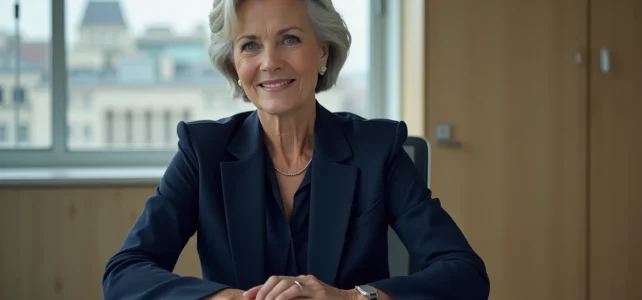
Since 2019, the presidency of the European Central Bank has been held by Christine Lagarde, former Managing Director of the International Monetary Fund. Her appointment marked a turning point, breaking with the tradition of appointing economists to this position.
The president’s mandate is set within a complex institutional context, where the ECB plays a central role in the monetary stability of the euro area. The decisions made under her leadership directly influence the economies and public policies of the member states.
The Central Role of the European Central Bank in the European Union
From Frankfurt, the European Central Bank has orchestrated the monetary policy of the euro area since 1998. Its priority remains the stability of the euro, a common pillar for nineteen countries with sometimes divergent interests. The ECB, fiercely independent, charts its own course without intervention from governments or other European institutions. Its roadmap? To maintain price stability, with a clear objective: to keep inflation around 2%. To achieve this, it relies on a concrete arsenal: adjusting key interest rates, supervising the banking sector, issuing the single currency, and, when the storm brews, launching asset purchase programs.
Here are the main bodies that structure the ECB and the role of the President of the European Central Bank:
- The Governing Council: it brings together the members of the Executive Board and the governors of the national central banks. It defines the major strategic directions.
- The Executive Board: composed of the president, the vice-president, and four members, it manages daily operations for a non-renewable eight-year term.
- The General Council: it also includes the governors of the central banks of all EU countries, even those that do not use the euro.
The president of the ECB embodies this authority. Coordination with the European Parliament, the European Commission, and the European Council is intended to be close. In banking matters, the ECB relies on the Single Supervisory Mechanism to monitor the solidity of the sector and avoid deviations that could weaken the system. This framework places the ECB at the center of the Eurosystem and the European System of Central Banks, the financial backbone of the continent. The choices made in Frankfurt are never trivial: they reverberate in the daily lives of households, businesses, and governments. The role of President of the European Central Bank thus emerges as a prominent function, analyzed in detail in the article: President of the ECB: Who Holds This Important Position? – Wype.
Who Currently Leads the ECB? Profile and Career of Christine Lagarde
At the helm of the European Central Bank today is Christine Lagarde. Since November 2019, she has held the presidency, becoming the first woman to lead this institution. Her arrival has disrupted the norms: where her predecessors had backgrounds in finance or academia, she brings experience in law and international management. After studying at the University of Paris X and Sciences Po Aix, she quickly made her mark at Baker & McKenzie, the law firm she led globally.
Her public career began in France: first as Minister Delegate for Foreign Trade, then as Minister of Agriculture, she later joined Bercy at a crucial moment. At the Ministry of Economy and Finance, she faced the financial crisis of 2008, negotiating, making decisions, and reinforcing her reputation as a woman of action. In 2011, she reached a new milestone by becoming the Managing Director of the International Monetary Fund (IMF), again, a first for a woman.
At the ECB, Lagarde instills a new culture, more open to exchange, pedagogy, and diversity. She emphasizes gender parity, engages with networks like Financi’Elles, and makes market listening a focus of her presidency. Her mandate, limited to eight years and non-renewable, comes at a pivotal moment: European monetary policy is evolving, the ECB is increasing its vigilance on inflation, while keeping an eye on banking supervision and transparency towards citizens.
The influence of Christine Lagarde extends beyond economic borders: she promotes constant dialogue with the European Parliament, the European Commission, and national governments, making consultation a pillar of European governance.
Challenges and Developments in European Governance Through the Presidency of the ECB
The European Central Bank relies on a dense institutional structure: a Governing Council that brings together the governors of the national central banks of the euro area and the members of the Executive Board, who are the guardians of the monetary line. The General Council, for its part, broadens the reflection to all EU countries, even those outside the euro area, highlighting the sought balance between national autonomy and common cohesion.
Since the arrival of Christine Lagarde, the governance of the ECB has transformed. The dialogue with the European Parliament, the European Commission, and the European Council has expanded. The institution, long perceived as a technical bastion, now accounts for its monetary choices, its supervision of the banking sector, and financial stability. Hearings before MEPs, the systematic publication of the minutes of the Governing Council, and increased transparency at each press conference testify to this evolution.
The issue of gender equality is also prominent in this landscape. In response to the underrepresentation of women, the ECB has launched an ambitious plan to diversify its executive ranks. This signal, sent from Frankfurt, goes beyond symbolism: it engages the very legitimacy of European governance. Diversity, inclusion, and accountability to citizens are asserted as contemporary demands. Regular interactions with the Court of Justice of the European Union, collaborations with the European Banking Authority, and the International Monetary Fund strengthen the ECB’s international anchoring, in tune with expectations for transparency and democratic rigor.
As global economic balances shift, the ECB shapes the rules of the game. There, in Frankfurt, the face of tomorrow’s financial Europe is drawn more clearly each day.